Five Auditory Illusions
February 23, 2008
1 CommentI’ve talked about the Shepard Tone before but NewScientist has just posted five great auditory illusions.
The virtual barber shop is fun! You’ll need headphones. I remember experiencing something like this at Disney World as a kid.
Phantom words creates the effect of a single word using separate sounds, demonstrating how your brain constructs meaning out of meaningless noise.
Temporal induction of speech shows how our brains fill in gaps when data is missing.
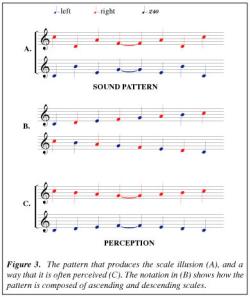
The scale illusion demonstrates how our brain groups notes together. See this image for the notation of what’s being played and what you are probably hearing.
Phantom melodies demonstrates how our brain picks out melodies from patterns at high-speeds.
Have fun!
If you want to be notified the next time I post something, sign up for email alerts or subscribe to my RSS feed. Thanks for visiting!


(1 votes, average: 5 out of 5)Absolute Pitch University Begins October 15th
October 8, 2007
0 CommentsMark your calendars. 12 weeks of intense “Music Hacking” begins on October 15th. Visit Absolute Pitch University for all the details. But you must do it fast because seats are strictly limited.
Sometimes, all it takes is a little hands-on mentoring to take you over the top. Visit www.AbsolutePitchUniversity.com today.


(No Ratings Yet)Audio Illusions: Shepard Tone
October 8, 2007
5 CommentsSo far, hundreds of Diggers are getting their mind’s blown over the Shepard tone audio Illusion. I have to agree. Listen to what I mean. When the video is done playing, replay it to hear the exact same audio seem to continually rise in pitch.


(1 votes, average: 4 out of 5)Brian Eno’s Oblique Strategies For Your iPhone
July 23, 2007
3 CommentsIn an attempt to hack their creativity and artistic output, Brian Eno and Peter Schmidt created a deck of cards they called the Oblique Strategies. Whenever they came up against a creative dilemma–and especially while under a moment of pressure or deadline–they would pull a card and follow the directions.
I’ve used this technique constantly in my creative pursuits. Whether it be composing, arranging, or songwriting, the Oblique Strategies have helped to keep me in a state of creative flow.
I wanted to create a mobile version since I find myself sans computer a lot now that I have my iPhone. This online version of the Oblique Strategies will work on any browser even though it’s optimized for iPhone.
Check it out and bookmark it if you like it: Oblique Strategies


(1 votes, average: 4 out of 5)The Path To Musical Excellence: Setting Clear Outcomes
January 9, 2007
0 CommentsNow that you have your musical strengths and weaknesses written down in a place that you will see everyday, it’s time to plan what to do with these lists.
Two Frames
For the best results in doing any kind of goal setting or personal change work, remember the following:
Problem Frame questions are less effective. This is when your goal or challenge is framed with the following questions:
- What’s wrong? Why is it a problem?
- Why do you have it?
- Whose fault is it?
- What caused it?
- Why can’t you solve it?
Outcome Frames are more effective. An effective outcome frame comes from answering the following questions:
- What specifically do you want? OUTCOME FRAME
- How will you know when you have it? EVIDENCE FRAME
- When, where and with whom do you want it? CONTEXT FRAME
- What will happen when you get it? ECOLOGY FRAME
- What stops you from having it now? LIMITS OF MODEL
- What resources do you have and need to get what you want? RESOURCE FRAME
- What will having it do for you? META-OUTCOME FRAME
- What will be your first step? PLANNING FRAME
I use this Well-Formed Outcomes Template on all of my goals.
There are four basic questions you need to ask to make this goal successful.
Four basic outcome questions:
- What am I moving towards? (The desired state or outcome)
- Why am I moving? (The values that guide you)
- How will I get there? (The strategy for the journey)
- What if something goes wrong? (Risk management and contingency planning)
There are nine questions you need to ask when working with outcomes. These are known as ‘the well-formed conditions.’ When you have thought them through, then your outcome will be realistic, achievable and motivating. These conditions apply best to individual outcomes.
How to structure outcomes:
- Positive: What do I want?
- Evidence: How will you know you are succeeding/have succeeded?
- Specifics: Where, when, and with whom?
- Resources: What resources do you have?
- Control: Can you start and maintain this outcome?
- Ecology: What are the wider consequences?
What time and effort will this outcome require?
Who else is affected and how will they feel?
What will you have to give up when you achieve this outcome?
What is good about the present situation?
What else could happen when you get your outcome?
- Identity: Is this outcome in keeping with who you are?
- How do your outcomes fit together?
- Action plan: What to do next?
Completed on
Many of the individual frames that contribute to an effective outcome frame are often overlooked. I’ll go into some of them later, but for now, the main points are to state the outcome in a positive form (”I want to play the Gflat scale at 250bpm.”), give a sensory-based description of the outcome (”I will feel loose and confident in my body, see ‘this image’ in my mind’s eye, hear ‘this sound’ on my instrument…”), make sure the outcome is appropriately contextualized (”When wouldn’t you want this?” “I wouldn’t want to write one song a week during certain holidays or vacations.”), the outcome is ecologically sound (”Is there any way this could be a problem?” “Writing one song a week could be a problem if it takes me more than 40 hours a week or causes other areas of my life to suffer.”), and the outcome is an appropriate, achievable chunk size.
Turn Your Weaknesses Into Strengths
The next step is to take the list of your musical weaknesses and turn them into positive outcomes. If your weakness is sight-reading, then create an outcome to practice sight-reading for 5 or 10 minutes a day while keeping a journal of what you learned. If your weakness is completing songs, create an outcome to finish and record one song a month. You can also take your list of musical strengths and determine how you would like to sustain and improve them. If your strength is creating melodies, set an outcome to create 5 new melodies every day.
Try the following exercise as a test to prove to yourself how powerful a written, well-formed outcome can be. Take two of your musical weaknesses and complete a well-formed outcome template for each of them. In two weeks, see how much closer you are to achieving these goals then you are to improving any of your other musical weaknesses on your list.
Go ahead, do it. I dare you. No, I double-dog dare you!


(1 votes, average: 5 out of 5)