Posts Tagged ‘Music Theory’

March 2nd, 2009
7:14 pm
No Comments
Rating: 1 Star2 Stars3 Stars4 Stars5 Stars
Loading ... Loading ...

Visualizing Relative Beat Strength

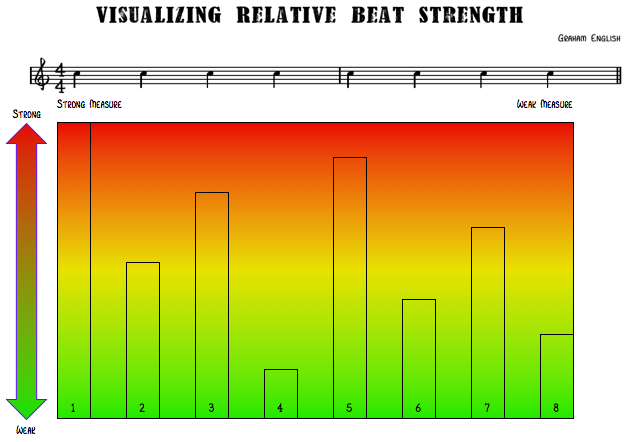
I was taught to organize rhythms into increments of two measures at a time. Some beats/pulses get a natural emphasis in relation to their placement in the measure. I put together this illustration of the most natural points of relative emphasis in a 2-measure unit of rhythm.


February 23rd, 2008
1:46 pm
1 Comment
Rating: 1 Star2 Stars3 Stars4 Stars5 Stars
Loading ... Loading ...

Five Auditory Illusions

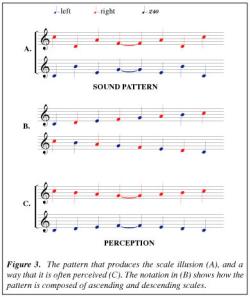
I’ve talked about the Shepard Tone before but NewScientist has just posted Five great auditory illusions.


December 24th, 2007
1:30 pm
No Comments
Rating: 1 Star2 Stars3 Stars4 Stars5 Stars
Loading ... Loading ...

The Best Of Graham English 2007

2007 was the year of social networking. Twitter occupied most of time which led to much less blogging. But 2007 was not without its controversies and celebrations. Read on…


April 23rd, 2007
5:14 pm
4 Comments
Rating: 1 Star2 Stars3 Stars4 Stars5 Stars
Loading ... Loading ...

How To Use Tension And Release In Your Melodies

Music, much like life, is fundamentally a swinging pendulum between tension and release. Fortunately, with music, this is easy to represent objectively and to utilize in your music composition.


April 9th, 2007
3:17 pm
No Comments
Rating: 1 Star2 Stars3 Stars4 Stars5 Stars
Loading ... Loading ...

Absolute Pitch Ear Training Podcast 04-09-07

Topics covered: Singing what you hear, the body/mind connection in music, exercises to improve your musicianship, and more.

 
 Absolute Pitch Ear Training Podcast 04-09-07: Play Now | Play in Popup | Download

March 28th, 2007
8:11 pm
5 Comments
Rating: 1 Star2 Stars3 Stars4 Stars5 Stars
Loading ... Loading ...

Confusing Music Theory Fundamentals And Cliche

Wanna hear something provocative? Check out this quote from an old issue of keyboard magazine.
“On this experimental record, I’ve been trying to explore more jazz harmonies. The thing is — and I’m gonna piss off a lot of people here — the II-V-I hits my barf button like nothing else. It’s the most horrible cadence [...]


March 12th, 2007
12:26 pm
4 Comments
Rating: 1 Star2 Stars3 Stars4 Stars5 Stars
Loading ... Loading ...

Fantastic Music Theory Resource

Dolmetsch online has made significant contributions to the world of early music. They also host a serious online music dictionary and composers biography. I especially like their 1000+ scales and practical guide to composition. Check it out.


December 19th, 2006
2:08 pm
1 Comment
Rating: 1 Star2 Stars3 Stars4 Stars5 Stars
Loading ... Loading ...

Top Music Theory Articles for 2006

Looking back over 2006 I can say that I learned a lot. And it seems that I taught a lot too! These music theory articles should keep you busy over the holiday break.

The Rules and Principles of Counterpoint
Deceptive Cadences
Advice To Beginning Musicians
How To Master Musical Textures
Internalize And Eternalize The Music By Transcribing Solos
Learn Orchestration Free [...]


November 15th, 2006
5:35 pm
1 Comment
Rating: 1 Star2 Stars3 Stars4 Stars5 Stars
Loading ... Loading ...

Is Your Ear Suspect?

If your ear can’t understand whatever it hears, then it’s suspect. Whatever the application — composing, songwriting, singing, playing the guitar, piano, or any other instrument — there is a logic to becoming a spontaneous musician. Your goal as a musician should be to get your musical intellect to the point where it becomes intuitive.


November 9th, 2006
11:07 am
10 Comments
Rating: 1 Star2 Stars3 Stars4 Stars5 Stars
Loading ... Loading ...

Why Singing What You Hear Is Important To Your Ear Training

Singing what you hear is an important part of improving your perception. Let’s look at it from a body/mind perspective.
Recognizing that C and F is a perfect fourth is a cognitive exercise. You have to think about it. Maybe only for a split-second, but you still have to translate your physical experience, a verb, into [...]


October 25th, 2006
12:46 pm
No Comments
Rating: 1 Star2 Stars3 Stars4 Stars5 Stars
Loading ... Loading ...

It’s Not Just The Notes You Play That Matters…

…but the person who plays the music.
You do a lot of work on your instrument technique, your knowledge of music theory, and your craft of music composition. Do you also have a plan to improve you, the musician?
Take two musicians and give them the same four bars of music to play. One musician will sound [...]


September 22nd, 2006
5:04 pm
5 Comments
Rating: 1 Star2 Stars3 Stars4 Stars5 Stars
Loading ... Loading ...

Who is Dick Grove?

DICK GROVE (1927-1998) had a distinguished career as a professional writer and composer in Los Angeles and as a unique innovator in the field of contemporary music education.
In 1973 he founded the world-renowned Grove School of Music in Los Angeles and guided this highly regarded institution into the top rank of leading contemporary music schools, [...]


August 18th, 2006
11:02 am
4 Comments
Rating: 1 Star2 Stars3 Stars4 Stars5 Stars
Loading ... Loading ...

The Rules and Principles of Counterpoint

Counterpoint: a composition which is written strictly according to technical rules. In earlier times, instead of our modern notes, dots or points were used. Thus one used to call a composition in which point was set against or counter to point, counterpoint; this usage is still followed today, even though the form of the notes [...]


August 14th, 2006
8:53 am
No Comments
Rating: 1 Star2 Stars3 Stars4 Stars5 Stars
Loading ... Loading ...

Deceptive Cadences

The progression from V to I has the name “authentic cadence” and from IV to I, “plagal cadence.” A “deceptive cadence” is understood to mean the substitution for the expected progression, V-I, of the progressions V-VI or V-IV.
The effect is strong because the deceptive cadence creates the possibility of preparing the actual close again and, [...]


August 11th, 2006
1:28 pm
1 Comment
Rating: 1 Star2 Stars3 Stars4 Stars5 Stars
Loading ... Loading ...

Advice To Beginning Musicians

If you’re new to the world of playing music or even if you’re just now thinking about playing your very first note, here’s my 7-step plan for beginning musicians:

Get a cheap instrument.
You probably have an idea of what instrument you want to play already. Don’t waste your money on the best instrument money can buy. [...]


August 10th, 2006
3:03 pm
No Comments
Rating: 1 Star2 Stars3 Stars4 Stars5 Stars
Loading ... Loading ...

How To Master Musical Textures

If you need more compositional choices or your music needs more depth, you might want to play with the textural qualities of music. This won’t be difficult because I’ve prepared a textural dictionary for you.

Polyphonic, while literally meaning “many-voiced,” refers to multivoiced texture of considerable interlinear independence, often imitative; it is understood to have qualitative [...]


July 18th, 2006
11:12 am
5 Comments
Rating: 1 Star2 Stars3 Stars4 Stars5 Stars
Loading ... Loading ...

Top Secret Patterns (shhh, they’re free!)

Patterns are a great way of putting scales to work. Not only do they get you out of any do-re-mi rut, they expand your musical vocabulary. They also expand your mind by forcing you to think about systems within systems—and sometimes within other systems. For example, this diminished pattern is a three note system:

within another [...]


July 8th, 2006
10:31 am
No Comments
Rating: 1 Star2 Stars3 Stars4 Stars5 Stars
Loading ... Loading ...

Harmony’s Hidden Geometry Revealed

THE GEOMETRY OF MUSICAL CHORDS
Dmitri Tymoczko, Princeton University
Musical chords have a non-Euclidean geometry that has been exploited by Western composers in many different styles. A musical chord can be represented as a point in a geometrical space called an orbifold. Line segments represent mappings from the notes of one chord to those of another. Composers [...]


June 15th, 2006
10:19 am
No Comments
Rating: 1 Star2 Stars3 Stars4 Stars5 Stars
Loading ... Loading ...

Who Else Wants To Master the Diminished Scale?

The diminished scale is an extremely creative tool. Due to the diminished chord’s symmetrical structure of stacked minor thirds, we have two options of diminished scales: half step-whole step and whole step-half step.

A major benefit to this scale is that you only have to learn it in three different keys since it repeats itself every [...]


December 9th, 2005
3:33 am
2 Comments
Rating: 1 Star2 Stars3 Stars4 Stars5 Stars
Loading ... Loading ...

The Golden Mean in Harmony Part 1

If you ride chaos all the way out to its edge, you find beauty and order… and the Blues
Chaos: complete disorder and confusion; behavior so unpredictable as to appear random, owing to great sensitivity to small changes in conditions; the formless matter supposed to have existed before the creation of the universe.
Chaos theory: The branch [...]


Subscribe

Get my music, audio/video, and articles delivered to you by RSS, iTunes, or email:


Your privacy is guaranteed.

More subscribe options...

about graham

I'm a songwriter and recording artist who sings, plays keyboards, and explores the vast world of sound hoping to find some magical moments along the way. I'm also a Mac geek.

TwitterCounter for @grahamenglish


facebook connect

Connect with Facebook


google friend connect


tags